
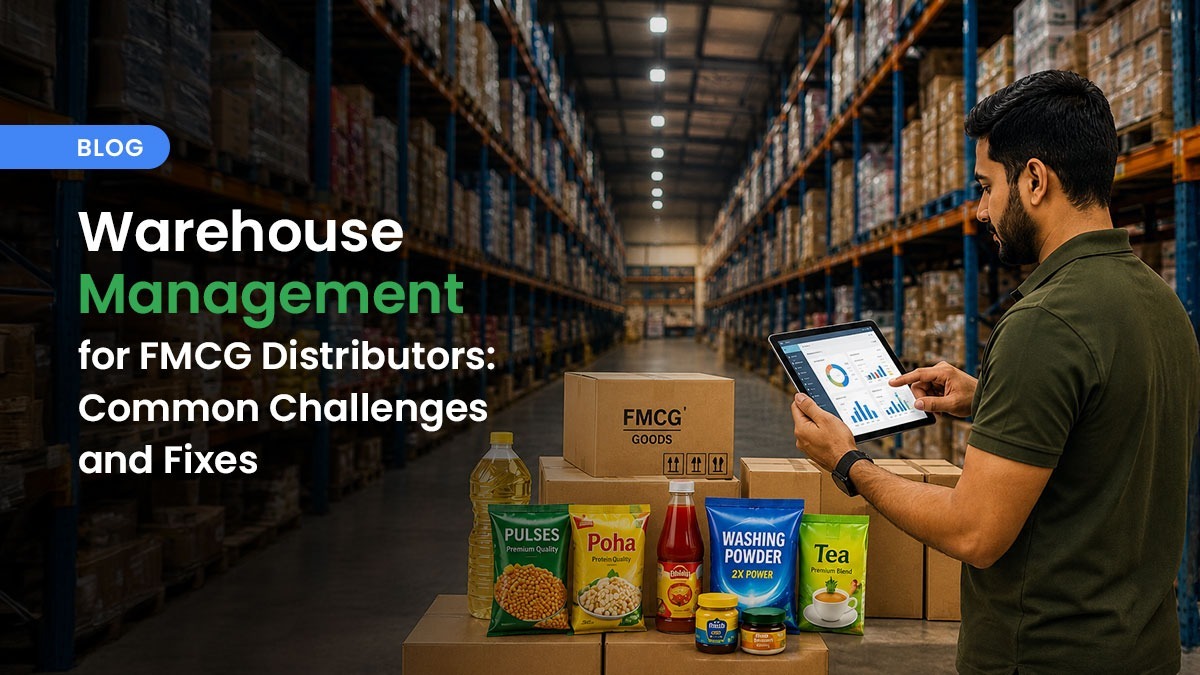
Managing a warehouse for Fast Moving Consumer Goods (FMCG) is far more demanding than handling various types of inventory. FMCG distributors deal with thousands of products. These products move quickly, have limited shelf lives & need timely deliveries to retailers plus users. Even a small inventory error, delayed shipment or expired product can lead to lost sales, dissatisfied customers as well as decreased profits.
Many distributors still rely on manual stock registers. They sometimes also depend on spreadsheets to manage warehouse operations. These methods may work for small firms but they become inefficient as operations grow. Poor inventory visibility, stock discrepancies plus slow order processing often prevent distributors from meeting increasing user expectations.
The solution lies in adopting a smarter approach to management of warehouses. A modern Warehouse Management System (WMS) automates inventory tracking. It also improves stock accuracy & consolidates warehouse operations from receiving to dispatch. In this blog we will explore the biggest warehouse challenges faced by FMCG distributors. We will also see the practical solutions that help improve efficiency & profitability.
Why FMCG Warehousing Is Harder Than It Looks?
Warehouse management in the FMCG industry is peculiar because distributors must balance inventory availability, product freshness & also fast order fulfillment. All this is managed whilst operating on thin profit margins.
High SKU Counts
FMCG distributors often manage hundreds or even thousands of SKUs all over the different brands, flavours, pack sizes & promotional variants. Every product must be tracked individually. This makes inventory management increasingly complex.
Short Shelf Life
Unlike durable goods, FMCG products come with expiry dates. Products that remain in storage for too long lose value. This results in discounts, returns or complete write-offs. Proper stock rotation is pivotal to decrease any sort of wastage.
Thin Profit Margins
FMCG enterprises depend on huge sales volumes. They don’t depend on large markups. Small operational errors like incorrect stock counts, picking mistakes, delayed dispatches can massively affect overall profitability.
Industry research shows that leading warehouses achieve inventory accuracy above 99.5%. Whereas firms using manual inventory management often struggle with much less precision. This gap directly impacts user satisfaction plus warehouse performance.
Common Warehouse Challenges Faced by FMCG Distributors
1. Frequent Stockouts of Fast Moving Products
Running out of huge demand products leads to lost sales & then ultimately unhappy customers. This is often caused by poor inventory visibility rather than low supply.
Solution: Use actual time inventory tracking. You can also use automated stock alerts to get desired inventory on time.
2 .Overstocking & Expiry Losses
Excess inventory maximizes storage costs. It often results in expired products hence decreasing profitability.
Solution: Implement FEFO (First Expiry, First Out) to make sure products nearing expiry are dispatched first.
3. Manual Inventory Counting
Managing stock on spreadsheets or paper records will lead to inaccurate inventory. It also leads to time consuming reconciliations.
Solution: Introduce barcode scanning. This is all made to automate stock updates plus improve inventory precision.
4 .Poor Visibility Across Multiple Warehouses
Not having centralized inventory management in some warehouses may lead to shortages whereas others will hold excess stock.
Solution: Use a centralized WMS to monitor & also upkeep inventory all over all warehouse locations.
5. Slow & Error Prone Order Fulfilment
Manual picking plus packing maximize the chances of incorrect orders & also leads to delayed deliveries.
Solution: Barcode guided picking improves speed, accuracy as well as order fulfilment efficiency.
6 .Disconnected Billing plus Compliance Documentation
Different warehouse or billing systems often create invoice mismatches. This also leads to issues in conformity.
Solution: Accommodate warehouse operations with centralized billing software. This will help to automate GST invoices, eWay Bills & delivery documents.
Practical Fixes and Best Practices
Warehouse performance improves significantly when companies amalgamate efficient processes with the right tech. Here are some proven best practices for FMCG distributors.
Adopt FEFO Instead of FIFO
For FMCG products First Expiry, First Out (FEFO) is more effective than traditional FIFO. You know why? Because itineraries with the nearest expiry date are dispatched first. This minimizes product wastage hence improves inventory rotation.
Track Inventory by Batch
Tracking records manufacturing dates with every batch. It also records expiry dates & supplier details for every single shipment. This changes traceability, simplifies product recalls & aids upkeep product quality.
Automate Inventory with Barcode Scanning
Scanning products during receiving, storage, picking as well as dispatch eliminates manual data entry. It also keeps inventory records updated in actual time.
Gain Complete Warehouse Visibility
Businesses operating multiple warehouses should manage inventory through one centralized dashboard. Actual time visibility aids in balancing stock between locations. It also prevents unnecessary shortages or overstocking.
Connect Billing with Warehouse Operations
Generating GST invoices, eWay Bills plus delivery documents directly from warehouse transactions. This will discard duplicate work all while improving billing accuracy & regulatory consent.
How a Warehouse Management System Solves These Problems
A modern Warehouse Management System (WMS) integrates every warehouse activity into one platform. This allows all distributors to automate operations plus make informed judgments.
Key benefits include
- Present time inventory visibility all over different warehouse plus storage location
- FEFO-based picking to decrease expiry losses
- Barcode enabled inventory management for improved stock accuracy
- Multi warehouse management from a centralized dashboard
- Faster order fulfilment with digital picking workflows.
- Automated GST compliant billing & eWay Bill generation.
- Actual time reporting plus analytics to support better company judgments.
Instead of reacting to warehouse problems after they occur a WMS helps prevent them through automation & real time data.
Manual Process vs. Warehouse Management System
| Challenge | Manual Process | With SmartWMS |
| Inventory Accuracy | Periodic manual updates | Real-time inventory tracking |
| Expiry Management | Manual checking | Automatic FEFO picking |
| Stock Tracking | Registers plus spreadsheets | Barcode based inventory |
| Multi-Warehouse Visibility | Different records | Centralized dashboard |
| Order Fulfilment | Manual picking | Barcode guided picking |
| Billing & Compliance | Manual documentation | Automated GST invoices & e-Way Bills |
| Reporting | Time taking reports | Actual time dashboards |
Why Warehouse Digitization Matters
As the FMCG industry continues to grow distributors are handling more products, orders & larger distribution networks than ever before. Manual warehouse management methods simply cannot keep up with this pace as these days demands are increasing.
A digital warehouse allows firms to decrease inventory losses, improve order accuracy, increase employee productivity & provide better user service. It also supports business growth by giving managers complete visibility into warehouse operations and inventory performance.
Investing in warehouse automation is no longer just about improving efficiency—it is about staying competitive in an increasingly fast-moving market.
Conclusion
Many warehouse problems are faced by FMCG distributors. These include stockouts, expiry losses, inaccurate inventory & delayed deliveries. All these share a common cause: limited visibility as well as manual processes. Addressing these issues demands more than temporary fixes. It needs a smarter way to manage warehouse operations.
SmartWMS helps FMCG distributors consolidate inventory management through real-time stock tracking, barcode scanning, FEFO based picking, multi warehouse visibility plus automated GST-compliant billing. With greater accuracy, faster fulfilment & improved operational control firms can decrease costs, minimize waste & also deliver a better customer experience.
If your warehouse is still dependent on spreadsheets or manual processes, now is the right time to upgrade to a solution designed for the speed and complexity of FMCG distribution.